PREVIOUSNEXT


Quarterly tribute:
Creative Change in EU Project Management
- tlab
- 05/01/2026
- 2:23 PM
- 0 comments
Digital Transformation in Erasmus+ Educational Programs
Erasmus+ has doubled funding to €26.2 billion, yet digital skills gaps persist across Europe. Project managers must align digital transformation strategies with EU frameworks, manage infrastructure constraints, and ensure compliance—turning policy commitments into measurable outcomes within real-world budgets and timelines.

1. The Scale of the Challenge: Quantifying Europe's Digital Education Gap
The European Union has doubled its investment in education, training, and youth mobility for 2021-2027, allocating €26.2 billion to the Erasmus+ programme—nearly twice the €14.7 billion earmarked for 2014-2020, according to the European Commission work programme adopted in April 2021. Yet this financial commitment confronts a persistent skills divide. Eurostat data from 2023 reveal that 80 percent of highly educated individuals in the EU possess basic digital skills, compared with just 34 percent of those with no or low formal education—a 46 percentage-point gap. In Portugal, Greece, and Malta, that gap exceeds 59 percentage points. For project managers designing Erasmus+ educational interventions, these figures underscore the urgency of embedding digital readiness and capacity building into every phase of project design, from eligibility criteria to quality assurance frameworks.
2. Policy Frameworks Driving Digital Transformation in Erasmus+ Projects
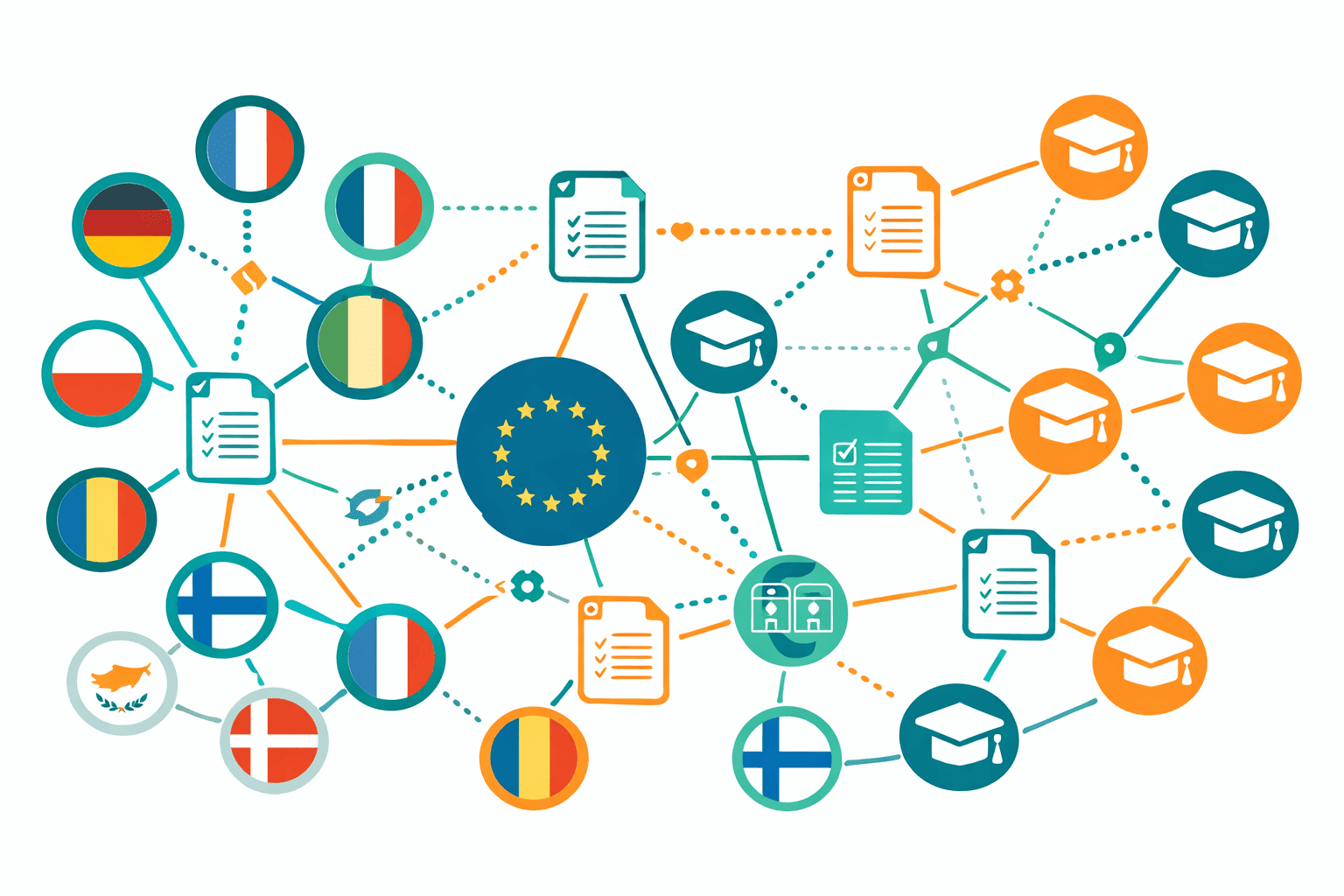
The Digital Education Action Plan 2021-2027 establishes two strategic priorities that frame all Erasmus+ digital initiatives: developing a high-performing digital education ecosystem and enhancing digital skills and competences for the digital transformation, according to the European Commission's education portal. The programme explicitly supports capacity building and critical understanding of digital technologies across all education and training sectors, requiring institutions to develop and implement digital transformation plans. This policy architecture aligns with the European Digital Education Hub, designed to connect national authorities, private sector actors, researchers, and civil society through cross-sectoral cooperation. For project managers, compliance with these frameworks is not optional: Erasmus Charter for Higher Education (ECHE) commitments mandate that participating institutions actively exchange digital learning agreements via the Erasmus Without Paper (EWP) Network.

3. Erasmus Without Paper: A Case Study in Infrastructure and Adoption Rates
The Erasmus Without Paper Network provides measurable evidence of both progress and remaining obstacles in digital transformation. In the 2021-2022 academic year, approximately 20,000 learning agreements were concluded digitally via EWP, according to the EWP statistical portal. By 2023-2024, that figure surged to more than 126,000 digital learning agreements—a sixfold increase. The European Commission and the EWP+ consortium have launched a Digital Learning Agreement (DLA) action plan for 2024-2025, targeting 95 percent of all intra-European mobility-for-studies learning agreements to be concluded digitally by the end of 2025. Recent reports indicate that the majority of programme countries have already exceeded 75 percent digital adoption. For project managers, this trajectory demonstrates the operational reality: digital infrastructure is no longer experimental but foundational, and institutions that lag face direct impacts on student experience, staff workload, and compliance risk.

4. Institutional Readiness: Strengths, Weaknesses, and Resource Constraints
An OECD assessment of digital readiness in Hungarian higher education, representative of challenges across Central and Eastern Europe, found that while most institutions possess basic network infrastructure and broadband access on campuses, the overall digital ecosystem remains "digitalized rather than digitally transformed". Infrastructure availability does not equal strategic integration. Similar issues characterize Ukrainian higher education, where connectivity exists but pedagogical and administrative transformation lags. Digital transformation requires applying technology to core strategic and operational challenges, not merely deploying isolated tools. For Erasmus+ project managers, this distinction is critical: budget lines for hardware procurement must be balanced with allocations for change management, staff training, data governance, and interoperability testing. Audit and documentation requirements mean that misaligned investments can trigger financial corrections or budget cuts during reporting cycles.
5. Building Digital Capacity: Frameworks, Competences, and Training Needs
The European Digital Competence Framework for Educators (DigCompEdu) describes 22 competences across six dimensions: professional engagement, digital resources, teaching and learning, assessments, empowering learners, and facilitating learners' digital competence. Validation studies among 597 vocational teachers in Switzerland and 109 teachers in Spain found relatively high overall competence but significant variation across dimensions. Teachers scored highest in "Digital Resources" and "Teaching and Learning" but showed deficits in using digital tools for augmented reality and advanced assessment methods. Erasmus+ Capacity Building for Higher Education projects such as Digital Move (2023-2026) in Mongolia and Vietnam, and DigItAfrica (2023-2026) in Guinea, Kenya, Madagascar, and Tunisia, explicitly address these gaps by establishing strategic digital transformation action plans, innovative teaching centers, institutional learning management systems, and competence training for students, staff, and lifelong learners. These multi-year interventions illustrate the resource commitment required to achieve sustainable capacity building.

6. Strategies for Project Managers: Aligning Digital Objectives with Compliance and Deliverables
Successful digital transformation within Erasmus+ projects demands alignment across three dimensions: strategic intent, operational feasibility, and compliance documentation. First, project applications must explicitly reference the Digital Education Action Plan priorities and demonstrate how proposed activities build institutional capacity or enhance digital skills. Second, workplans should include realistic timelines for technology procurement, system integration, piloting, and iterative refinement, recognizing that infrastructure deployment is only the starting point. Third, monitoring dashboards and key performance indicators (KPIs) must capture both quantitative adoption rates—such as percentage of staff trained or digital tools deployed—and qualitative outcomes, including changes in pedagogical practice or learner engagement. Budget narratives should itemize costs for technical support, training facilitators, and change management consultancy, not just hardware and software licenses. Risk logs must account for interoperability failures, vendor lock-in, and data protection compliance, particularly under the General Data Protection Regulation (GDPR). Audit trails require documenting decision rationale, procurement processes, and outcome assessments at every milestone.

7. Positioning for 2025 and Beyond: Continuity, Scalability, and Evidence-Based Adaptation
The European Commission's confirmation that the Erasmus Without Paper infrastructure will remain available at least until the end of the current programming period provides critical stability for ongoing and future projects. Continuity and consolidation of existing technical solutions are prerequisites for completing the digital transition of the Erasmus+ programme, according to the EWP Consortium. For project managers, this means that investments in EWP-compatible systems carry lower obsolescence risk than proprietary alternatives. Scalability becomes feasible when institutions achieve the 95 percent digital learning agreement target, enabling data-driven analysis of mobility patterns, learner outcomes, and institutional performance. The Western Balkans Digital Economy and Society Index (WB DESI) 2024 report, benchmarking six Western Balkan economies against EU standards, highlights persistent gaps in digital skills, infrastructure, business digitalization, and public services. Erasmus+ projects targeting candidate and potential candidate countries must therefore incorporate baseline assessments, phased implementation, and adaptive management protocols to address heterogeneous starting conditions and resource constraints.