PREVIOUSNEXT


Quarterly tribute:
Creative Change in EU Project Management
- tlab
- 14/07/2025
- 11:57 PM
- 0 comments
AMIF: Supporting Migration and Integration Projects A Comprehensive Guide for EU Project Managers
Explore how AMIF’s €9.88 billion fund supports migration management, integration, and solidarity across the EU through innovative projects that transform challenges into opportunities for migrants and communities.

1: Understanding AMIF
- What is AMIF? The Asylum, Migration and Integration Fund (AMIF) is the European Union’s primary financial instrument for migration management, with a budget of €9.88 billion for the 2021-2027 period.
- What are its main objectives? AMIF aims to strengthen the Common European Asylum System, promote legal migration and integration of third-country nationals, counter irregular migration, and enhance solidarity among Member States.
- Who manages AMIF? The fund operates under dual management: 63.5% through joint programmes between the EU and Member States, and 36.5% directly managed by the European Commission.
- What makes AMIF unique? Unlike previous fragmented funding mechanisms, AMIF consolidates asylum, migration, and integration support into one comprehensive instrument, ensuring coherent policy implementation and improved efficiency across all migration-related challenges.
2: AMIF’s Budget and Management Structure
AMIF’s €9.88 billion budget represents the EU’s largest investment in migration management. The fund’s allocation methodology is data-driven: Member States receive funding based on asylum applications received, return decisions implemented, and the number of third-country nationals residing within their territories. Joint management programmes account for €6.27 billion, enabling Member States to develop national programmes tailored to their specific migration challenges. The remaining €3.61 billion under direct EU management supports emergency assistance, resettlement operations, and relocation mechanisms. This dual structure ensures both local responsiveness and EU-wide coordination. Germany’s Federal Office for Migration and Refugees exemplifies effective national management, processing applications and monitoring project implementation. The budget also includes provisions for Ukraine refugees, demonstrating AMIF’s adaptability to emerging crises. This financial architecture promotes both accountability and flexibility in addressing diverse migration scenarios.
3: Key Objectives and Strategic Focus Areas
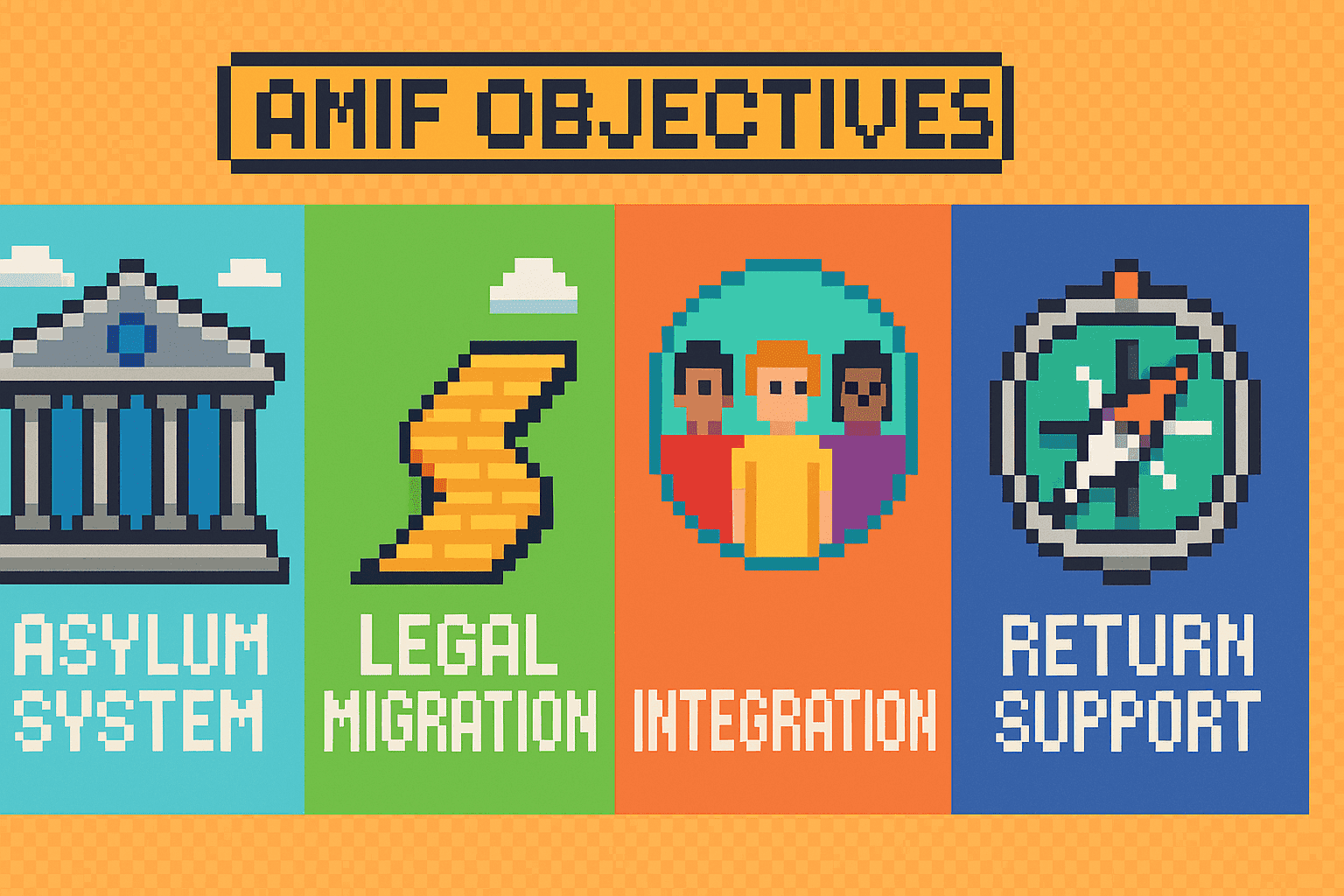
AMIF operates across four strategic objectives that form the backbone of EU migration policy. Objective 1 strengthens the Common European Asylum System by improving reception conditions, enhancing asylum procedures, and developing early identification systems for vulnerable applicants. Objective 2 promotes legal migration aligned with Member States’ economic and social needs while facilitating administrative processes and reducing bureaucratic delays. Objective 3 supports integration and social inclusion through tailored programmes that help third-country nationals become active community members. Objective 4 addresses irregular migration through safe, dignified return procedures and reintegration support in countries of origin. These objectives are interconnected and mutually reinforcing. The fund also prioritizes solidarity mechanisms, including practical cooperation initiatives that distribute migration pressures more equitably among Member States. Each objective includes specific performance indicators and measurable outcomes, ensuring accountability and effectiveness in project implementation across diverse national contexts.

4: Migration Challenges and Contemporary Context
Contemporary migration challenges require sophisticated responses that AMIF addresses systematically. The fund responds to unprecedented displacement scenarios, including the largest forced migration in Europe since World War II due to Russia’s aggression against Ukraine. Mediterranean and Western Balkan routes continue generating complex protection needs requiring coordinated responses. Administrative delays remain a persistent challenge, with some Member States experiencing bottlenecks in processing asylum applications and issuing residence permits. Integration challenges include language barriers, employment access, and social inclusion difficulties that require long-term support strategies. Unaccompanied minors represent a particularly vulnerable group, with 1,276 new arrivals in Greece during 2021 alone, requiring specialized accommodation and protection systems. Digital transformation needs include modernizing migration management systems and improving data sharing among Member States. These challenges demonstrate why comprehensive, well-funded approaches like AMIF are essential for effective migration governance in an increasingly connected world.

5: Notable AMIF Projects and International Cooperation
AMIF’s external dimension includes significant investments in migration partnerships beyond EU borders. The EU Trust Fund for Africa received €135 million in AMIF funding during 2014-2020, representing 38% of external expenditure. The Regional Development and Protection Programme in North Africa (RDPP NA) addresses root causes of displacement while supporting refugee protection. Similarly, the Horn of Africa programme focuses on long-term development solutions for protracted displacement situations. The Migration Partnership Facility facilitates cooperation with key transit and origin countries. The Re-admission Capacity Building Facility supports third countries in developing effective return and reintegration systems. InfoMigrants, another key initiative, provides reliable information to migrants and communities. These projects demonstrate AMIF’s comprehensive approach, addressing migration challenges at their source while supporting protection and development goals. The fund’s external investments total €357.7 million, showcasing the EU’s commitment to addressing migration through international cooperation and development partnerships.

6: Integration Support and Complementary Funding Mechanisms
AMIF’s integration component provides dedicated support for third-country nationals without time limitations, distinguishing it from mainstream social programmes. The fund complements the European Social Fund Plus (ESF+) and other shared management resources by focusing specifically on migration-related integration needs. Integration projects address employment access, language training, civic orientation, and social participation. The fi-compass AMIF workstream, launched in 2022, provides specialized advisory support on financial instruments for integration initiatives. This workstream offers publications, workshops, targeted coaching for managing authorities, and innovative financing mechanisms. Integration funding supports vulnerable groups including women, children, elderly migrants, and persons with disabilities through tailored interventions. Projects also address housing challenges, with specific actions providing accommodation and improving living conditions for international protection applicants. Digital integration initiatives help migrants access online services and participate in digital society. These comprehensive integration approaches ensure that migration becomes an opportunity for both migrants and receiving communities.

7: Developing Successful AMIF Projects
Successful AMIF project development requires understanding EU priorities, national contexts, and beneficiary needs. Projects must include robust monitoring and evaluation strategies with key performance indicators measuring both quantitative outputs and qualitative outcomes. Baseline data collection and target setting are mandatory requirements for demonstrating project impact. Cross-border cooperation and transnational partnerships enhance project effectiveness while promoting knowledge sharing. Projects addressing unaccompanied minors must provide holistic support from first reception through long-term integration. Digitalization initiatives should modernize administrative processes while maintaining human-centered approaches. Successful projects demonstrate innovation, sustainability, and scalability potential. Risk management strategies must address implementation challenges including administrative delays and coordination difficulties. Projects should engage multiple stakeholders including government agencies, civil society organizations, and migrant communities themselves. Finally, successful AMIF projects contribute to broader EU migration policy objectives while addressing specific local challenges through evidence-based interventions that promote dignity, protection, and integration.